Same Species, Different Clocks: Migration That Shapes Reproductive Timing in Birds
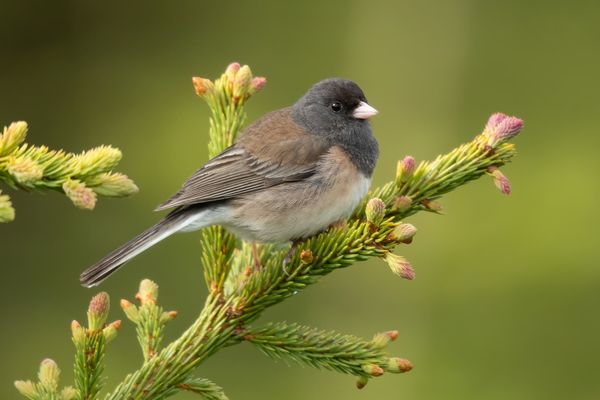
A Dark-eyed Junco (Junco hyemalis oreganus) in the fresh light of spring. While this species isn’t featured in the study, it serves as a reminder of how migration and seasonal timing weave together in the lives of birds across latitudes. © Ilya Povalyaev

Same Species, Different Clocks: Migration That Shapes Reproductive Timing in Birds

Why do some birds get ready to breed while others are still preparing to migrate—despite living in the same place? The answer lies in how they sense time.

Share this post
World Curlew Day: The Long Decline of Curlews, Now Fully Understood
Far Eastern Curlew (Numenius madagascariensis) occupying a landscape under pressure, mirroring a wider pattern in which curlews endure but rarely recover despite increasing clarity around their decline © Brendan Tucker

World Curlew Day: The Long Decline of Curlews, Now Fully Understood

Curlews are not disappearing unnoticed. The causes of their decline are now well understood, yet across flyways and landscapes, recovery remains limited and uneven — raising a harder question about the scale and persistence of our response.


Gyorgy Szimuly

Gyorgy Szimuly

What Do Shearwaters Eat? Uncovering a Mediterranean Food Web
The Mediterranean endemic, Yelkouan Shearwater, relies heavily on small pelagic fish such as anchovies and mackerel, linking its fortunes closely to the region’s marine food web. © Jessica Joachim

What Do Shearwaters Eat? Uncovering a Mediterranean Food Web

DNA metabarcoding and stable isotope analysis reveal how two Mediterranean shearwaters share the same prey — and what that overlap tells us about life in a changing marine ecosystem.


Gyorgy Szimuly

Gyorgy Szimuly

Evolution or Plasticity? What the Hermit Thrush Reveals About Climate Change
Long regarded as stable, the Hermit Thrush now reveals how environmental change can leave measurable imprints on form and function. © Mark Daly

Evolution or Plasticity? What the Hermit Thrush Reveals About Climate Change

Over four decades, a familiar North American songbird has grown smaller. But genomic evidence reveals that not all of these changes are evolutionary – some may simply reflect the remarkable plasticity of living organisms in a warming world.


Gyorgy Szimuly

Gyorgy Szimuly

Fabricated Birds: AI and the Future of Ornithology
AI-generated image. A Shoebill (Balaeniceps rex) in papyrus habitat. The bird depicted here does not exist – a reminder that in the age of generative imagery, realism is no longer proof of presence. Image created by Daniel Szimuly/The Ornithologist. All rights reserved.

Fabricated Birds: AI and the Future of Ornithology

When we generated a Shoebill that never existed, the realism was flawless – and unsettling. In an age where synthetic plausibility becomes effortless, ornithology must reconsider what authenticity means and how it is protected.


Gyorgy Szimuly

Gyorgy Szimuly