Not So Solitary: Female Ruffs Cluster Nests Around Leks and Neighbours
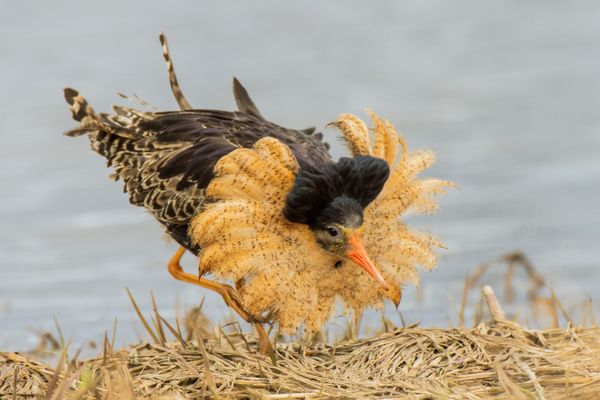
The spectacular male display is the visible centre of a breeding system shaped just as strongly by female choice. © Sergey Volkov

Not So Solitary: Female Ruffs Cluster Nests Around Leks and Neighbours

Female Ruffs reveal a hidden social strategy: new research shows their nests cluster around leks and neighbours, reshaping how we understand habitat selection in this declining wader.


Share this post
Is Woodpecker Drumming More Than Noise?
Syrian Woodpecker – Drumming is one of the most conspicuous signals in a woodpecker’s behavioural repertoire, yet its evolutionary role is often taken for granted — recognised immediately, but rarely interrogated in the way birdsong has been. © Pavel Štěpánek

Is Woodpecker Drumming More Than Noise?

Conceptual Note: This piece sits deliberately between observation and explanation: it outlines what is currently supported by evidence, then turns to the not knowing that remains — treating uncertainty not as a failure of understanding, but as a necessary part of how knowledge advances. The forgotten song Among birds, few behaviours are as immediately recognisable as the drumming of a woodpecker. Long before the bird itself is seen, the rapid, percussive burst carries


Gyorgy Szimuly

Gyorgy Szimuly

American Oystercatchers Take to the Rooftops: A Desperate Response to a Shrinking Coastline
An American Oystercatcher on a gravel rooftop nest shows a precarious adaptation as shrinking shorelines force birds to seek refuge above ground. © Kara Durda, Audubon Florida

American Oystercatchers Take to the Rooftops: A Desperate Response to a Shrinking Coastline

As coastal nesting habitats disappear, American Oystercatchers along Florida’s Gulf Coast are turning to gravel rooftops—an extraordinary but risky adaptation driven by urban expansion and shrinking shorelines.


Abigail McKay

Abigail McKay

Bound by Coastlines: Genetics and the Hidden Structure of Mexico’s American Oystercatchers
American Oystercatchers along the coast of north-western Mexico inhabit a landscape shaped by strong site fidelity, where breeding populations remain closely tied to specific bays and shorelines despite their ability to travel long distances.© Rain Saulnier

Bound by Coastlines: Genetics and the Hidden Structure of Mexico’s American Oystercatchers

Genetic evidence from Mexico’s coastlines reveals that American Oystercatchers are far less mobile than they appear, shaped by loyalty to place and hidden evolutionary boundaries.


Gyorgy Szimuly

Gyorgy Szimuly