The Ornithologist Launches ‘Conceptual Notes’: Exploring the Unanswered Questions in Ornithology
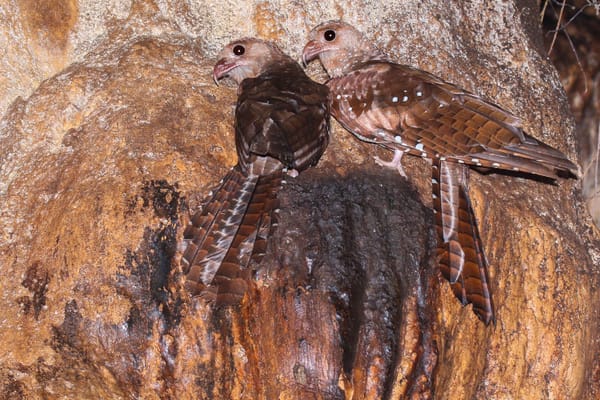
Oilbirds (Steatornis caripensis), among the few birds to use echolocation. Their nocturnal world challenges the assumption that birds are primarily visual animals – a fitting emblem for a series that explores what lies beyond familiar explanatory light. © Alex Berryman

The Ornithologist Launches ‘Conceptual Notes’: Exploring the Unanswered Questions in Ornithology


Share this post

The Ornithologist has launched a new editorial series titled Conceptual Notes, designed to give space to questions, uncertainties, and unresolved patterns that sit just beyond the boundaries of conventional scientific publishing.

The series responds to a familiar tension in ornithology and ecology: while journals excel at reporting methods, results, and conclusions, there is far less room to discuss the moments before hypotheses solidify, or the ambiguities that persist even after decades of research. Conceptual Notes aims to occupy that gap – not as speculation, but as disciplined reflection grounded in evidence and field experience.

Rather than presenting new datasets or definitive answers, each Conceptual Note outlines what is currently supported by research, then deliberately turns toward what remains unclear, contested, or insufficiently explored. The intention is not to undermine established knowledge, but to treat uncertainty as a productive component of scientific thinking rather than something to be edited out.

The first published notes, including a reflection on woodpecker signalling and a discussion of naming conventions in the European Roller, illustrate this approach. Each piece is anchored in established research, careful in its claims, and explicit about the limits of current understanding.

Conceptual Notes is not positioned as an opinion column, nor as a substitute for peer-reviewed literature. Instead, it is conceived as a complementary space – one that may be useful to researchers, field ornithologists, and advanced birders alike, particularly those interested in theory formation, interpretation, and the framing of future research questions.

By launching this series, The Ornithologist continues to expand its role beyond science communication alone, positioning itself as a platform where ornithological thinking – not only results – can be shared, tested, and refined. Researchers and practitioners are invited to engage with the series, whether as readers, contributors, or critical interlocutors.

If you would like to follow the series or contribute to future Conceptual Notes, please visit the dedicated page or get in touch directly.

Explore

Share this post
Comments

Be the first to know

Join our community and get notified about upcoming stories

Subscribing...
You've been subscribed!
Something went wrong
How European Is the European Roller?
European Roller in Hungary — a bird still closely associated with Europe by name, even as much of its population and range now lie far beyond the continent’s western edge. © Attila Szilágyi

How European Is the European Roller?

Conceptual Note: This piece sits deliberately between observation and explanation: it outlines what is currently supported by evidence, then turns to the not knowing that remains — treating uncertainty not as a failure of understanding, but as a necessary part of how knowledge advances. The European Roller carries one of the most self-assured names in ornithology. It sounds precise, settled, geographically honest. Yet the bird it describes has always been only partly Eu


Gyorgy Szimuly

Gyorgy Szimuly

Is Woodpecker Drumming More Than Noise?
Syrian Woodpecker – Drumming is one of the most conspicuous signals in a woodpecker’s behavioural repertoire, yet its evolutionary role is often taken for granted — recognised immediately, but rarely interrogated in the way birdsong has been. © Pavel Štěpánek

Is Woodpecker Drumming More Than Noise?

Conceptual Note: This piece sits deliberately between observation and explanation: it outlines what is currently supported by evidence, then turns to the not knowing that remains — treating uncertainty not as a failure of understanding, but as a necessary part of how knowledge advances. The forgotten song Among birds, few behaviours are as immediately recognisable as the drumming of a woodpecker. Long before the bird itself is seen, the rapid, percussive burst carries


Gyorgy Szimuly

Gyorgy Szimuly

American Oystercatchers Take to the Rooftops: A Desperate Response to a Shrinking Coastline
An American Oystercatcher on a gravel rooftop nest shows a precarious adaptation as shrinking shorelines force birds to seek refuge above ground. © Kara Durda, Audubon Florida

American Oystercatchers Take to the Rooftops: A Desperate Response to a Shrinking Coastline

As coastal nesting habitats disappear, American Oystercatchers along Florida’s Gulf Coast are turning to gravel rooftops—an extraordinary but risky adaptation driven by urban expansion and shrinking shorelines.


Abigail McKay

Abigail McKay