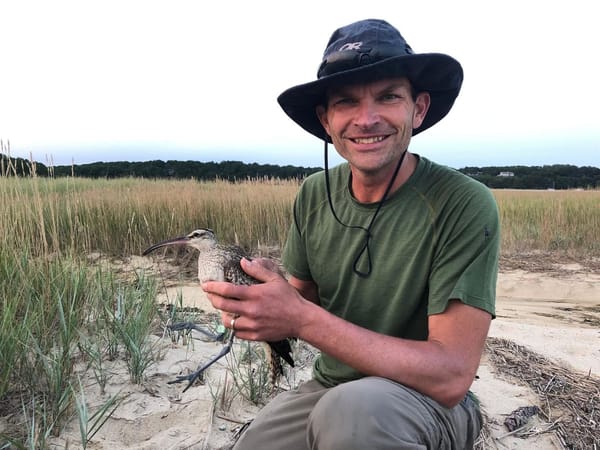
In Memoriam: Dr. Shiloh Schulte (1978–2025)
Image credit: Manomet

In Memoriam: Dr. Shiloh Schulte (1978–2025)

Dr. Shiloh Schulte, a devoted shorebird biologist and quiet force in conservation, passed away doing what he loved most—protecting the birds he championed.


Share this post

Shorebird scientist, mentor, and field conservationist whose impact stretched far beyond the tide lines he studied.

Dr. Shiloh Schulte, Senior Shorebird Scientist at Manomet, tragically passed away in early June 2025 in a helicopter crash en route to a remote field site in Alaska. He and the pilot lost their lives doing what he loved most: protecting shorebirds in the places they call home.

Throughout his career, Shiloh became one of the most recognised voices in North American shorebird conservation. As coordinator of Manomet’s American Oystercatcher Recovery Program, he led a 45% population rebound along the Atlantic and Gulf coasts—an achievement attributed to his collaborative, data-driven conservation model and tireless field leadership. In interviews, he emphasised that only coordinated monitoring, predator management, and habitat restoration on a range-wide scale could reverse the species’ decline.

His research also spanned Whimbrels, Red Knots, Piping Plovers, and many more species, all guided by his belief that conservation begins with understanding—and understanding begins in the field. Whether deploying transmitters, performing fieldwork, or mentoring students, he was a field biologist in the truest sense.

Shiloh was a generous communicator. Though we never met in person, we exchanged messages for nearly two decades—and he never failed to respond. He shared insights, encouragement, and support when few others did. He was among the very first to embrace the idea of creating World Shorebirds Day, offering his full support and participation from the very beginning. That quiet generosity made him beloved across both professional and citizen-science communities—he made everyone feel their contribution mattered.

He leaves a powerful legacy: thriving shorebird populations, strengthened conservation networks, and a generation of researchers inspired by his integrity and passion.

Dr. Schulte is survived by his wife and two daughters. His passing is a profound loss, but his spirit flies on with every coast he helped protect—and every bird he championed.


Share this post
Comments

Be the first to know

Join our community and get notified about upcoming stories

Subscribing...
You've been subscribed!
Something went wrong
Sound-based surveys uncover fine-scale habitat selection in the declining Crested Tit
Forest birds are often assumed to depend primarily on age and maturity, yet fine-scale structure and composition may shape habitat use long before breeding begins. © Steve Roach

Sound-based surveys uncover fine-scale habitat selection in the declining Crested Tit

New research from Finland suggests that Crested Tits respond more to fine-scale forest structure than to forest age in early spring, challenging assumptions about how habitat quality is defined in managed boreal forests.


Gyorgy Szimuly

Gyorgy Szimuly

Choosing Survival: Habitat Shifts in Wintering Taiga Bean Geese
Winter landscapes can appear rich in food, yet a few degrees below zero can render familiar feeding grounds unusable. For Taiga Bean Geese, survival depends on recognising when to abandon frozen pastures and seek alternative refuges. © Lars Petersson

Choosing Survival: Habitat Shifts in Wintering Taiga Bean Geese

When frost locks grasslands out of reach, Taiga Bean Geese turn to winter cereal fields to survive. New research shows how these fields become lifelines during the coldest days of winter.


Gyorgy Szimuly

Gyorgy Szimuly

Bound by Coastlines: Genetics and the Hidden Structure of Mexico’s American Oystercatchers
American Oystercatchers along the coast of north-western Mexico inhabit a landscape shaped by strong site fidelity, where breeding populations remain closely tied to specific bays and shorelines despite their ability to travel long distances.© Rain Saulnier

Bound by Coastlines: Genetics and the Hidden Structure of Mexico’s American Oystercatchers

Genetic evidence from Mexico’s coastlines reveals that American Oystercatchers are far less mobile than they appear, shaped by loyalty to place and hidden evolutionary boundaries.


Gyorgy Szimuly

Gyorgy Szimuly

Cormorants: Evolutionary Failure or Underwater Mastermind?
A Spotted Shag demonstrates the streamlined form typical of shags. The same low-drag profile that supports agile flight also contributes to the precise underwater manoeuvrability seen across the cormorant family. © Jeremiah Trimble

Cormorants: Evolutionary Failure or Underwater Mastermind?

Cormorants are often labelled evolutionary misfits for having partially wettable feathers – hardly ideal for a diving bird. Their design is far from flawed. It is a finely tuned adaptation that reveals an unexpected path in the evolution of underwater hunting.


Gyorgy Szimuly

Gyorgy Szimuly